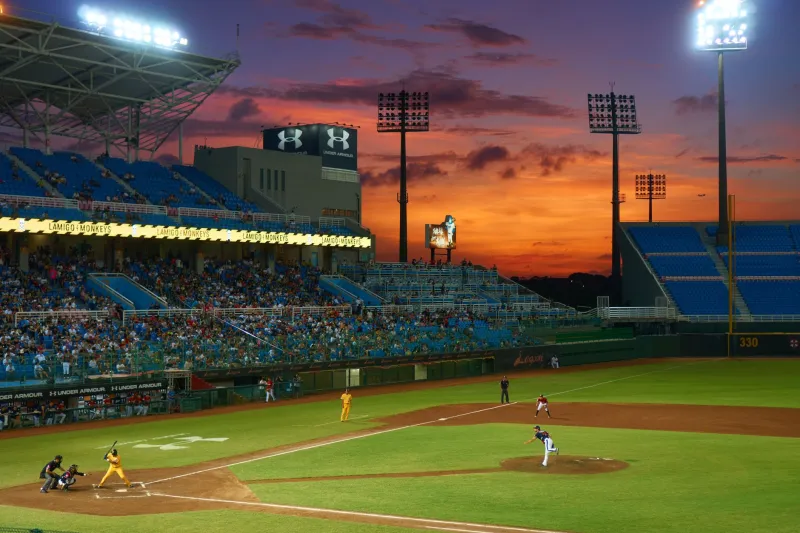
Dirt Roads to the Big Leagues: How Texas Turned High School Baseball Into a Major League Assembly Line
There's a moment every spring in small towns all across Texas — somewhere between the first warm Wednesday in February and the crack of that opening-day lineup card — when baseball stops being a sport and becomes something closer to religion. Bleachers fill up before the first pitch. Grandparents sit in lawn chairs down the first-base line. Local radio announcers call the game with the same gravity they'd give a playoff run. And somewhere in the middle of all that, a seventeen-year-old kid winds up on the mound and throws something that makes a major league scout reach for his radar gun.
That scene plays out hundreds of times a year across 254 counties, and it's no accident. Texas doesn't just produce baseball players — it manufactures them at a rate that would make any industrial operation jealous.
The Numbers Don't Lie
Pull up any MLB roster on any given Opening Day and start counting Texas birthplaces. The results are staggering. According to Baseball Reference data compiled over the last decade, Texas consistently ranks as either the first or second state in terms of active MLB players born within its borders, trading the top spot back and forth with California despite having a significantly smaller overall population. In recent draft classes, Texas high schoolers have routinely accounted for more first-round picks than any other state's prep programs.
The 2023 MLB Draft alone featured nine players from Texas high schools selected in the first three rounds. Teams like the Houston Astros, Texas Rangers, and San Antonio-connected prospects have made Lone Star alumni a cornerstone of their organizational depth charts. But this isn't just a regional story — franchises from Boston to Los Angeles have built championship cores around Texas-born talent.
Roger Clemens came out of Spring Woods High School in Houston. Lance Berkman grew up in Waco. Nolan Ryan — the patron saint of Texas baseball — honed his fire in Alvin, a small town southeast of Houston that has since turned his legacy into a coaching ethos that filters down through every level of the game in the state.
The Coaches Who Built the Machine
Ask anyone in Texas baseball circles who deserves credit for the pipeline, and the conversation inevitably turns to the coaches — lifers who could've gone elsewhere, made more money, and chose instead to stay rooted in their communities and pour everything they had into teenagers with big dreams.
Wayne Graham spent over three decades at Rice University, but his fingerprints stretch back through the Houston-area high school programs that fed his college dynasty. Graham built a culture of accountability and fundamentals so deeply ingrained that players who passed through his program — including future big leaguers like Lance Berkman and Jose Cruz Jr. — carried those habits straight into professional clubhouses.
At the high school level, names like Lonnie Goldberg at Westlake High School in Austin have become synonymous with consistent excellence. Westlake has produced a remarkable number of Division I signees and professional prospects over the years, operating out of a program philosophy that emphasizes mental toughness alongside physical development. Goldberg has been quoted saying he doesn't just coach baseball — he coaches how to compete, how to handle failure, and how to show up every single day. Those aren't just baseball lessons. Those are life lessons that happen to translate beautifully to a 162-game grind in the majors.
Down in the Rio Grande Valley, coaches working with far fewer resources have nonetheless sent players to affiliated ball with remarkable regularity. The disparity in facilities between a program like Katy or Allen in the DFW suburbs and a small school in Laredo is enormous — but the passion isn't. That competitive fire that exists everywhere in the state, regardless of zip code, is part of what makes Texas different.
The Culture Factor
You can't fully explain the Texas baseball pipeline without talking about culture, and culture in this state is deeply tied to community identity. In towns like Brenham, Corpus Christi, or Midland, the high school baseball team isn't just a team — it's a source of civic pride that stretches across generations. Fathers who played in the eighties bring sons who'll play in the twenties. Barbecue joints put winning records on their marquee signs. Local newspapers still run full box scores.
That level of community investment creates a pressure cooker environment where young players either crumble or develop a mental edge that follows them for the rest of their careers. Major league scouts have long noted that Texas kids tend to arrive at professional camps with a different kind of polish — not just in their physical tools, but in their ability to handle the spotlight without flinching.
The state's climate helps too. Texas kids play year-round. While prospects in the Northeast are waiting out February snowstorms, a kid in Beaumont or San Angelo is already three weeks into his spring workouts. That extra repetition adds up to thousands of additional swings, throws, and competitive at-bats by the time draft day arrives.
Today's Roster Check: Who's Repping the Lone Star Right Now?
The current generation of Texas-born MLB talent is as deep as any in recent memory. Corey Seager, born in Blountville but developed through the Texas baseball culture after his family relocated, now anchors the Rangers' infield as a World Series champion. Marcus Semien, who grew up in the Bay Area but built his MLB career in a Texas uniform, represents the other side of the equation — players drawn to Texas rather than from it.
Among the truly homegrown, Kyle Tucker — a Tampa native who came up through the Houston system — and a wave of younger arms currently working through minor league rosters suggest the pipeline isn't slowing down anytime soon. Draft analysts point to Texas high school classes in 2024 and 2025 as particularly loaded, with multiple potential top-ten picks already generating serious buzz from national scouting services.
What the Rest of the Country Is Finally Admitting
For a long time, the conventional wisdom in professional baseball placed California at the absolute top of the talent pyramid, with Florida and Texas fighting for second. That conversation has shifted. Multiple front offices have quietly relocated their amateur scouting operations to better cover Texas, stationing full-time area scouts in Houston, Dallas-Fort Worth, and San Antonio specifically because the volume and quality of prospects demands it.
One veteran scout, speaking on background to Lone Star Dugout, put it simply: "If I miss a kid in Texas, I'm not doing my job. There are too many of them, and they're too good. You can't take your eyes off this state for a single spring."
That's the thing about the Texas baseball pipeline. It doesn't need anyone's validation. It just keeps humming along, turning out ballplayers the way the Permian Basin turns out oil — steadily, reliably, and in quantities that keep the whole operation running. From the dusty high school diamonds scattered across the Hill Country to the gleaming showcase facilities in the suburbs, this state has figured out something the rest of the country is still trying to copy.
And somewhere right now, on a Wednesday afternoon in February, a seventeen-year-old kid is winding up on a mound — and a scout is reaching for his radar gun.